 Back to the Blog
Unlocking retail success with video analytics: Understanding customer behavior
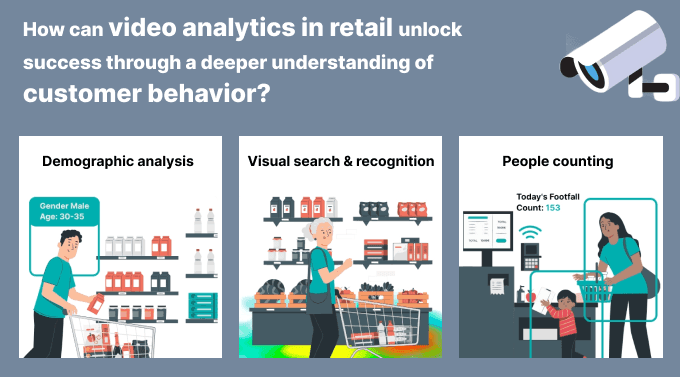
In today’s hyper-competitive world, it has become essential to understand customers. Nowadays, shoppers expect personalized experiences, prompt service, and smarter store layouts. Retail businesses are adopting AI video analytics, converting CCTV footage into effective insights. These are influential in decoding the behavior of customers, enhancing sales performance, and optimize operations. In this blogpost, we are going to explore how retail video analytics is revolutionizing the way retail businesses operate. From identifying popular zones to predicting the purchasing intent, AI-powered Video Analytics in Retail empowers brands to create smarter, data-backed decisions that improve engagement, amplify sales as well as build brand loyalty.
How can AI video analytics for retail analyze customer patterns & behavior?
Video surveillance in retail can be utilized for security and loss prevention. With the evolution of AI and computer vision, retail businesses can now extract actionable insights from every frame of video data. With the integration of AI video analytics into retail operations it provides a comprehensive tool for advancing customer experiences and optimizing store performance, marking a transformative step in retail management.
From improving customer experiences to streamlining supply chains and advancing security measures, AI is reshaping the way retail businesses operate. The comprehensive overview emphasizes the versatility and influence of AI, providing retailers with insights into harnessing the technologies to stay competitive.
Prediction of customer intent & behavior trends
Leveraging the advanced algorithms enable retail businesses to recognize different behavioral cues like body language, dwell time, and customer engagement. It enables real-time assistance, personalized digital signage, and advanced marketing strategies.
Real-world use cases of AI in reshaping the retail industry
Driven by the integration of AI across its operations, the retail industry is revolutionizing rapidly. Beginning from footfall analysis to heat mapping, queue management, and customer emotion tracking, AI-powered video analytics administers a cluster of benefits that make it a great choice for retailers.

Comprehending customer movement patterns
Manual monitoring of customer movements is tedious and challenging when it comes to retail marketplaces. Powered with Video Analytics in Retail, businesses can visualize the flow of customers through the store and departments that mostly attract people’s attention, and linger the longest. By recognizing high-traffic zones, brands can simply place high-margin products strategically. Additionally, one can redesign store layouts and advance in-store experiences for driving impulse purchases.
Managing inventories
AI offers a convenient platform where AI can administer a dynamic solution to this problem via predictive analytics and automated restocking. These systems enable retailers to adjust their inventory levels in real time, lowering waste and maximizing sales opportunities. With the means of integrating AI video analytics, retailer businesses can immediately recognize as shelves trigger automatic restocking processes.
Increased customer service
Besides comprehending customer behavior and managing inventory, it plays a vital role in improving customer service. With the process of monitoring customer interactions and queues in real-time, AI tools can alert managers for deploying additional staff at the time of peak times. AI in the retail industry comprises chatbots and virtual administering round the clock customer service.
Personalized marketing & recommendations
AI systems effectively analyzes customer data comprising purchase history, preferences, and browsing history. Retailers can target an audience who seems to have displayed similar interests, combined with personalized offers. It provides platforms integrating customer data from various sources comprising video analytics for delivering personalized marketing strategies. The personalized approach of marketing not only builds customer loyalty but also maximizes brand exposure.
Supply chain management
AI algorithms are empowered to predict demand more accurately, considering certain factors such as historical data and market trends. It assists retailers in obtaining a precise idea of the shortages and overstockings. Major enterprises and global brands are embracing advanced tools for streamlining supply chain logistics and management.
Virtual assistants & chatbots
Nowadays, companies are leveraging virtual assistants and AI chatbots to answer questions and help with purchases. Powered by AI, the tools comprehend and process natural language, enabling them to communicate with customers in a more human-like manner. Owing to their round the clock assistance, retailers can utilize this insight for refining visual merchandising, making products easily available to customers, and gaining customer satisfaction.
Encouraging loss prevention with customer insights
AI-powered video analytics assist in recognizing suspicious activity, abnormal movements, and shoplifting patterns. A similar system helps in recognizing the purchasing intent assisting retailers lower shrinkage while maintaining a positive shopping environment.
Customer segmentation & targeting
For best results, customer segmentation is the key aspect to target specific groups with custom marketing campaigns. Depending on preferences and behavior, it enables retailers to target different specific groups. The customer segmentation powered by AI is empowered to analyze customer data and automate the creation of targeted campaigns resonating with distinct groups of customers.
AI-powered product recommendations
When it comes to online retail, AI recommendations provide customers with personalized suggestions depending on their purchasing and browsing history. Powered by recommendations, leveraging machine learning algorithms can predict products when a customer is interested in the subsequent purchases. When customers get an easy sneak peek at their desirable products, retail businesses can increase sales, bring loyalty, and enhance customer satisfaction.
Detecting potential fraud
Manual supervision can be challenging and comes with different errors that are unavoidable. Artificial Intelligence, on the contrary, can detect and prevent fraud in the retail industry. It can analyze transactional patterns and recognize anomalies, helping in flagging fraudulent activities. From identifying anomalies to scanning suspicious behavior at the point of sale, AI is capable of detecting suspicious activities in real-time.
Queue management
With the means of analyzing footage of checkout areas, AI tools are capable of predicting queue lengths, leveraging real-time data for adjusting checkout staffing and many more. Having a proactive approach, queue management assists in ensuring a smooth and pleasant shopping experience for customers.
Visual search & recognition
Adopting visual search technology not only improves customer experiences but also enables shoppers to get their desired products/services. In the retail industry, visual search and recognition help stores automate inventory tracking, detect misplaced items, and acquire insights into customer preferences. It bridges the gap between offline and online retail, improving engagement and overall effectiveness.
Predictive maintenance
AI enables predictive maintenance leveraging sensor data and machine learning for predicting tools. The enterprises specialized in AI technologies and IoT provide solutions that can be applied in retail contexts for preventing equipment failures. Real-time customer feedback analysis By extracting valuable insights from reviews, analyzing customer feedback in real-time, and customer service interactions. Different tools from companies harness AI to process and analyze vast amounts of feedback, assisting retailers in staying responsive to customer requirements and market trends.
People counting
The application of AI cameras can accurately track the number of people entering and exiting a retail space. Using advanced computer vision and deep learning algorithms, the AI-powered people counting can accurately detect individuals in real time. It analyzes movement patterns as well as traffic flow across distinct areas. It helps businesses improve safety standards, optimize space utilization, and improve safety.
Final thought
AI-powered visual search and recognition systems are revolutionizing the way customers communicate with retail brands. The combination of personalization, intelligence, and convenience creates shopping experiences that are faster and human. With retailers embracing innovation, every image becomes an opportunity, and every interaction drives insight.
Frequently asked questions
What is AI-powered people counting?
AI people counting utilizes computer vision and machine learning for detecting individuals within a given area through video feeds. It provides exact real-time occupancy and footfall data.
Where do AI-powered people counting systems become influential?
The AI-people counting software is widely used in retail stores, corporate offices, events, smart buildings, and public spaces for monitoring visitor flow, managing crowd density, and optimizing resource allocation.
What are the advantages of AI Retail Analytics?
The different advantages involve energy optimization, better space management, safety compliance, queue management, and improved customer experience.
Can AI people counting protect privacy?
Yes, advanced Customer Behavior Analysis systems are GDPR-compliant and leverage anonymous data processing, ensuring that individuals are not personally identifiable in analytics.
How do retailers benefit from people counting analytics?
Retail businesses can understand peak hours, footfall trends, and customer conversion rates enabling them to store layout, staff deployment, and other marketing strategies.